
Where to Find Jobs in Singapore for Fresh Graduates
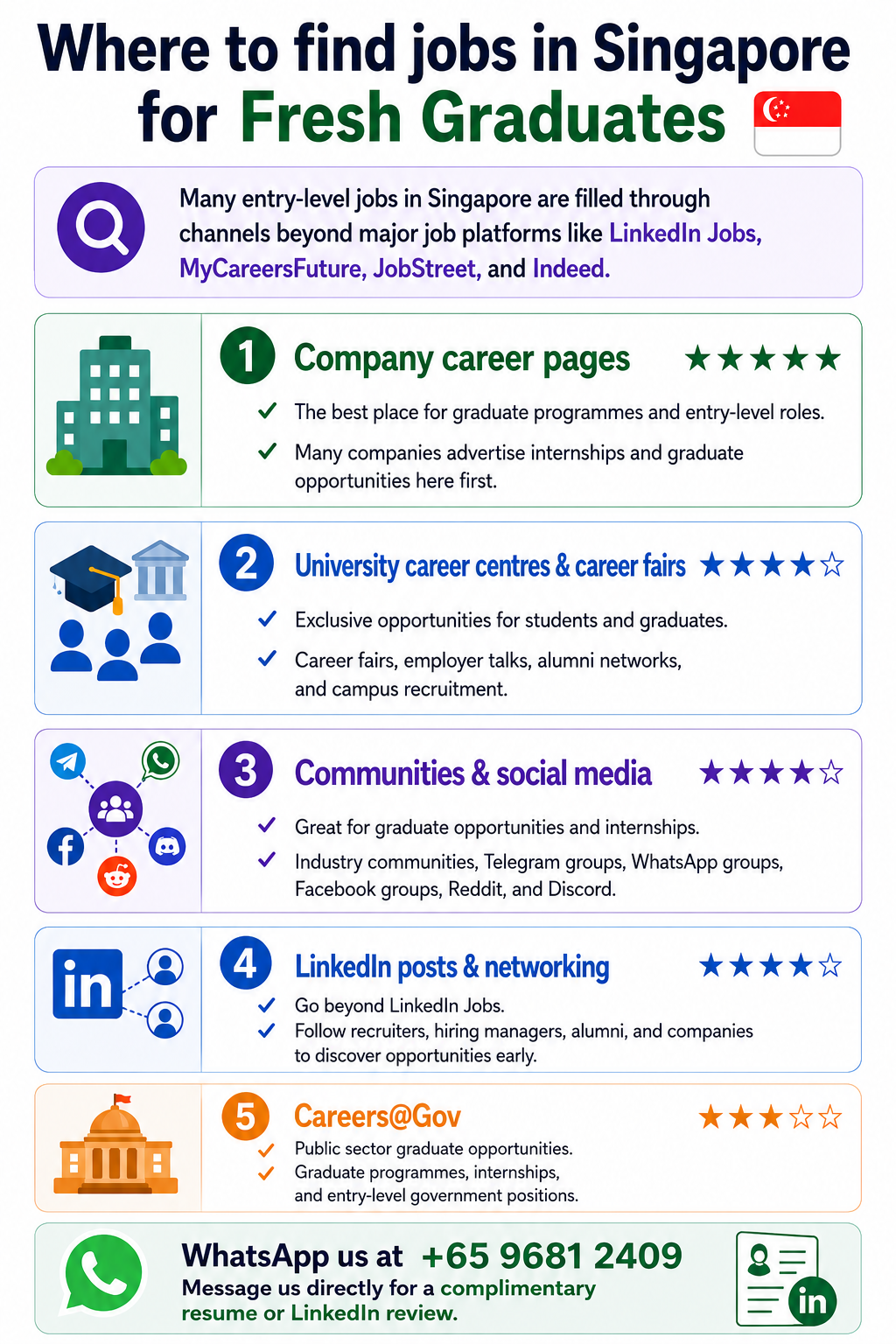
Where to Find Jobs in Singapore for Fresh Graduates
Expert Q&A Guide by CV Writer Singapore
Many fresh graduates focus almost entirely on job portals when starting their job search.
While platforms such as LinkedIn Jobs, MyCareersFuture, JobStreet, and Indeed are important, they are only part of the picture.
In Singapore, many graduate programmes, internships, and entry-level opportunities are advertised through company career pages, university career centres, professional networks, and employer events before candidates even discover them on major job boards.
A successful job search is not just about having a good resume. It is also about knowing where to look.
This guide explains where fresh graduates should focus their job search efforts to maximise their chances of securing interviews.
Who This Guide Is For
This guide is suitable for:
- University graduates
- Polytechnic graduates
- Students entering the workforce
- Fresh graduates looking for their first full-time job
- Graduates applying for internships or graduate programmes
- Malaysians seeking graduate opportunities in Singapore
Q1. Where should fresh graduates start their job search?
Start with company career pages.
Many employers advertise graduate programmes and entry-level roles on their own websites before posting them elsewhere.
Large organisations often recruit directly through their careers page for:
- Graduate programmes
- Management Associate programmes
- Internships
- Entry-level professional roles
If you have target employers in mind, check their careers page regularly rather than waiting for vacancies to appear on job portals.
Q2. Are job portals still useful?
Absolutely.
Platforms such as:
- LinkedIn Jobs
- MyCareersFuture
- JobStreet
- Indeed
remain important parts of any job search strategy.
They provide access to thousands of vacancies across different industries.
However, relying solely on job portals may cause you to miss opportunities advertised elsewhere.
Q3. Why should I use my university’s career centre?
Many universities and polytechnics have exclusive employer partnerships.
Career centres often provide access to:
- graduate recruitment programmes
- internship opportunities
- employer networking sessions
- career fairs
- alumni referrals
Some employers recruit directly from campuses before advertising positions publicly.
Even after graduation, many institutions continue offering career support to alumni.
Q4. Are career fairs still worth attending?
Yes.
Career fairs allow graduates to:
- meet recruiters directly
- ask questions about available roles
- learn about hiring requirements
- leave a positive first impression
Speaking with employers face-to-face can help your application stand out when you apply later.
Q5. Can social media actually help me find a job?
Yes.
Professional communities often share opportunities before they become widely advertised.
Useful platforms include:
- Telegram groups
- WhatsApp communities
- Facebook groups
- Discord
Industry communities also discuss:
- hiring trends
- graduate programmes
- interview experiences
- referral opportunities
These channels should complement, not replace, traditional job searching.
Q6. How important is LinkedIn beyond applying for jobs?
Very important.
Many graduates only use LinkedIn to search for vacancies.
However, recruiters also use LinkedIn to search for candidates directly.
Follow:
- recruiters
- hiring managers
- companies
- alumni
- industry leaders
Engaging professionally with content can improve your visibility and help you learn about opportunities before they are formally advertised.
Q7. Should I consider Careers@Gov?
Yes, especially if you are interested in the public sector.
Careers@Gov advertises:
- graduate programmes
- internships
- entry-level public sector careers
- scholarships
- government agency positions
Public sector recruitment often follows structured hiring processes with clear career development pathways.
Q8. Should I only apply to advertised jobs?
No.
Some companies welcome speculative applications through their career pages, even when no suitable vacancy is currently advertised.
Building connections with recruiters and attending employer events can also lead to future opportunities.
A proactive job search often produces better results than waiting for vacancies to appear.
Q9. How many job search channels should I use?
Use several.
A balanced strategy might include:
- Company career pages
- Job portals
- University career services
- Professional communities
- Careers@Gov
Relying on only one platform reduces your chances of discovering suitable opportunities.
Q10. What mistakes do fresh graduates commonly make?
Common mistakes include:
- relying only on one job portal
- applying with the same resume to every job
- ignoring LinkedIn
- missing career fairs
- failing to follow target companies
- waiting until graduation before starting their search
The strongest candidates prepare early and use multiple job search channels simultaneously.
Q11. Does where I apply matter as much as my resume?
Yes.
A strong resume improves your chances of being shortlisted.
However, you first need to find the right opportunities.
Successful graduates combine:
- targeted job searching
- ATS-friendly resumes
- LinkedIn optimisation
- networking
- interview preparation
Finding the right opportunity and presenting yourself well go hand in hand.
Q12. What is the best job search strategy for fresh graduates?
The most effective strategy combines:
- monitoring company career pages
- searching major job portals daily
- attending career fairs
- building a professional LinkedIn presence
- joining relevant communities
- applying consistently
Do not wait for opportunities to come to you.
The graduates who secure interviews fastest are usually those who search widely, prepare early, and remain proactive throughout the process.
Final Thoughts
There is no single “best” place to find graduate jobs in Singapore.
Successful job seekers use multiple channels because different employers recruit in different ways.
Rather than relying only on job portals, broaden your search by including:
- company career pages
- university career services
- LinkedIn networking
- professional communities
- Careers@Gov
Combining a strategic job search with a strong resume and LinkedIn profile will significantly improve your chances of securing interviews.
Need Help Preparing Your Resume or LinkedIn Profile?
WhatsApp us at +65 9681 2409
CV Writer Singapore helps fresh graduates improve:
- ATS resumes
- LinkedIn optimisation
- graduate job applications
- interview preparation
- Singapore PMET positioning
Useful resource:
https://www.cvwriter.com.sg/job-boards/best-job-sites-in-singapore/

 WhatsApp Us